From 2025 to 2026: Preparing Spatial Data Infrastructure for What’s Next

Contents
Looking Back at 2025: Foundations for What Comes Next
As 2025 draws to a close, it’s clear that the geospatial industry is transitioning to a new era. The volume, variety, and expectations around spatial data have accelerated rapidly, pushing organizations to rethink how they store, manage, and analyse location-based information. For Ellipsis Drive, this year marked an important step forward. Not just in terms of product milestones, but in how we continue to support this fast-evolving ecosystem.
One of the most notable shifts in 2025 was a growing demand for European cloud deployments. Concerns around data sovereignty, regulatory compliance, and security are no longer peripheral. They are central to infrastructure decisions. In response, we expanded partnerships and capabilities to ensure Ellipsis Drive can meet these needs seamlessly, without adding complexity for our users. (More on that in the upcoming blogs!)
At the same time, the launch of Ellipsis Map Engine represented a major milestone in the progress of our industry's geospatial compute capabilities. By extending Ellipsis Drive with scalable distributed compute capabilities across all geospatial data types (including raster) we took another step toward making spatial data analytics-ready by default. This reflects a broader industry movement: spatial workflows are no longer just about visualisation or rigid workflows, but about enabling flexible compute, full automation, and seamless integration at scale.
Yet, beyond technology, our biggest highlight of 2025 remained our users. Continuous collaboration helped shape improvements across access control, data syncing, and overall platform usability. As our CEO Rosalie said in her end of year video address, “The true highlight of our work this year was to collaborate closely with our users to further elevate their experience when managing, sharing and using spatial data.”
Zooming out, these developments mirror a wider reality in the geospatial landscape. While data diversity and analytical ambition continue to grow, much of today’s infrastructure still struggles to keep pace. Legacy systems were not designed for distributed analytics, AI-ready pipelines, or the operational demands of modern data teams.
As we look ahead to 2026, this gap (between where the industry is going and what current infrastructure can support) becomes impossible to ignore.
Key Trends Shaping 2026: Diversification and AI
Looking ahead to 2026, two major trends are set to redefine the geospatial landscape:
Diversification of Datasets: Spatial data is no longer confined to simple vectors or occasional raster imagery. Organizations now generate high-resolution satellite mosaics, dense point clouds, environmental time-series, mobility data, and more. This diversity opens the door to richer insights but also creates challenges around storage, accessibility, visualization and computation. The ability to seamlessly manage and analyse this variety of data will be a defining factor for success in the coming year.
Integration of AI into workflows: AI is becoming an essential tool rather than a luxury. From natural language-based querying to enabling predictive analytics, AI can transform raw spatial data into actionable intelligence. However, AI workflows require data infrastructures that are flexible, scalable, and capable of supporting distributed computation. Without the right foundation, organizations risk bottlenecks that prevent them from fully leveraging AI’s potential.
As Rosalie put it, the future belongs to “companies that are operating systems capable of handling the enormous variety of geospatial data, supporting distributed analysis, and providing the foundation for AI-powered tools.”
Yet today, most infrastructures lag behind these ambitions. Fragmented tools, siloed datasets, and rigid pipelines mean that, while the possibilities are exciting, the practical reality of deploying AI at scale is still a challenge for many teams.
This gap between ambition and capability frames the central question for 2026: Is the current geospatial infrastructure ready for these trends? The short answer is: not yet. And addressing this is exactly where Ellipsis Drive is focusing its efforts next.
Ellipsis Drive in 2026: Building the Future of Spatial Data
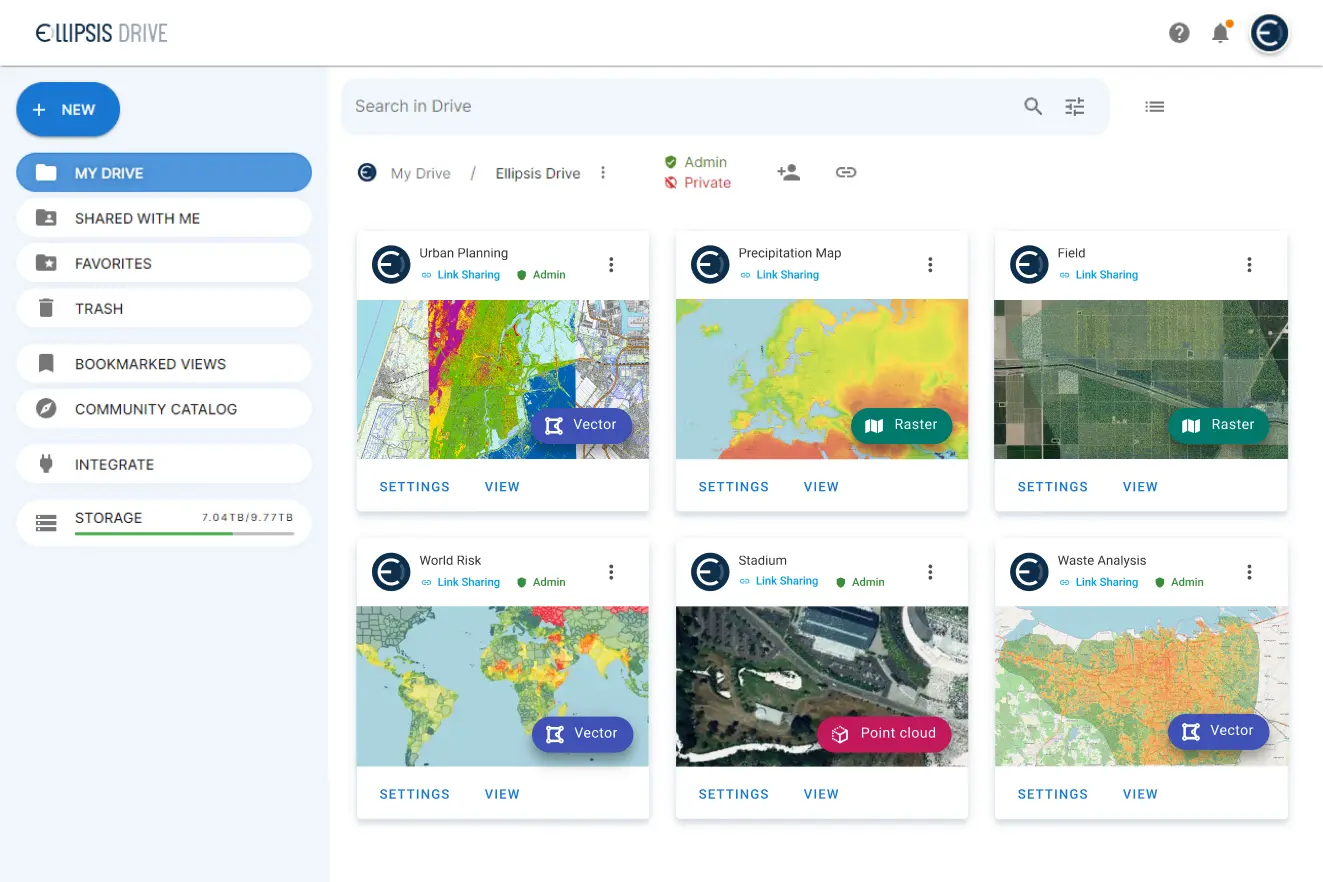
In 2026, Ellipsis Drive is focused on closing the gap between the promises of the geospatial industry and the reality of today’s infrastructure. Our mission remains clear: provide a flexible, scalable foundation that empowers organizations to manage, share, and analyse spatial data regardless of type, volume, or velocity.
With Ellipsis Map Engine, users can already perform distributed, automated analytics across complex datasets, including raster and time-series data. In 2026, we’re taking this further: building pipelines that are inherently AI-ready, integrating seamlessly with modern workflows, and enabling instant access to insights whenever they are needed.
For our users, this means a future where technology works in the background, supporting innovation rather than slowing it down. As Rosalie notes, “Adding Ellipsis Drive and Ellipsis Map Engine to your stack provides the flexibility, scale, and automation needed to leap into the future.”
Conclusion
The road ahead is exciting. Spatial data is more diverse, workflows are more intelligent, and organizations are asking for more than ever before. Ellipsis Drive is committed to delivering the infrastructure that makes this progress possible, ensuring 2026 is not just a year of growth, but a year of transformation, for our users, the geospatial community, and the broader data ecosystem.
Liked what you read?
Subscribe to our monthly newsletter to receive the latest blogs, news and updates.
Take the Ellipsis Drive tour
in less than 2 minutes'
- A step-by-step guide on how to activate your geospatial data
- Become familiar with our user-friendly interface & design
- View your data integration options