AI
3 Questions to Ask When Planning Your Data Storage Strategy
Contents
Introduction: Start With the Data, Not the Storage
Modern data strategies often begin with a deceptively simple question: where should we store our data?
But as we explored in The Misconceptions Behind Modern Data Strategies, this can be the wrong place to start. Data is not homogeneous. Different datasets have different structures, access patterns, performance requirements, and applications. And trying to force everything into one storage strategy can leave an organization with infrastructure that works, but is never truly optimized.
So if the answer isn't simply “put everything in one place,” what should guide the decision?
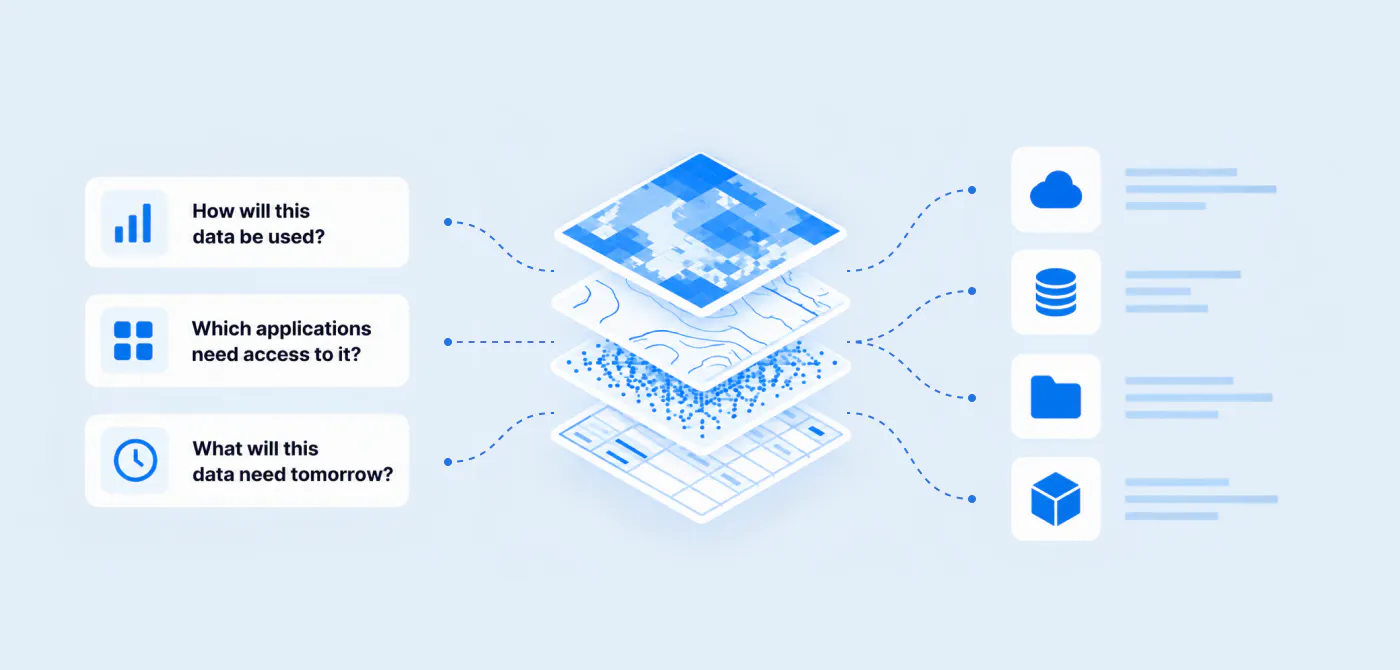
There are three questions worth asking before designing a modern data storage strategy:
How will this data be used?
What applications need access to it?
What will this data need tomorrow?
Together, these questions shift the focus from where data lives to what the infrastructure needs to enable.
How Will This Data Be Used?
`The first question is perhaps the most fundamental: how will this data actually be used?
Different workloads create different requirements. Data used for complex analytics may need very different capabilities from data that is accessed through an API, streamed into an operational application, or maintained as a long-term archive.
The same is true for spatial data. Raster, vector, point clouds, and meshes can all have different access patterns and processing requirements. Treating them interchangeably simply because they are all “data” can introduce unnecessary compromises.
Understanding the intended use of the data therefore needs to come before choosing the storage technology.
Instead of asking, “Where can we put this data?”, ask: “What does this data need in order to be useful?”
That answer provides a much stronger foundation for the architecture that follows.
What Applications Need Access to It?
The second question moves beyond the data itself: what applications and workflows need to access it?
Storage doesn't exist in isolation. It sits underneath the systems that make data useful.
A dataset might be visualized in a GIS, queried by a data scientist, consumed through an API, processed by an AI workflow, or used by an operational application. Each of these can place different demands on the underlying infrastructure.
This means storage shouldn't simply be evaluated on whether it can hold the data. It should be evaluated on whether it can effectively support the applications that depend on it. Otherwise, the relationship gets reversed. Instead of infrastructure enabling workflows, workflows have to adapt to the limitations of the infrastructure.
Over time, those compromises can accumulate into slower applications, additional data movement, duplicated datasets, and increasingly complex workarounds.
So the real goal is to create an infrastructure that supports the way data is actually consumed.
What Will This Data Need Tomorrow?
The third question is harder to answer: what will this data need tomorrow?
A storage strategy is rarely designed for a static environment. Data volumes grow. New datasets are introduced. Applications change. And entirely new ways of working with data emerge.
AI is a clear example. As organizations begin using AI to discover, query, analyze, and process data, infrastructure that was designed around yesterday's workflows may suddenly face new requirements.
That doesn't mean organizations need to predict every future technology or design for every possible scenario, but it does mean building enough flexibility into the architecture that change doesn't immediately become a constraint.
A storage strategy should therefore consider today's workloads, and also how data volumes, applications, and processing requirements might evolve.
The objective is to avoid making the future unnecessarily difficult.
Conclusion: Build Around What the Data Needs
A modern data storage strategy doesn't start with choosing a place to put everything.
It starts with asking the above mentioned questions.
The answers may point toward different storage technologies, architectures, or even multiple locations. And that's not necessarily a problem.
The goal of modern data infrastructure is to make the ecosystem work better. When storage is designed around the data, the workflows that consume it, and the requirements that may emerge tomorrow, infrastructure becomes an enabler rather than a constraint. And this goal naturally gets accomplished.
Liked what you read?
Subscribe to our monthly newsletter to receive the latest blogs, news and updates.
Take the Ellipsis Drive tour
in less than 2 minutes'
- A step-by-step guide on how to activate your geospatial data
- Become familiar with our user-friendly interface & design
- View your data integration options