Buy or Build Spatial Data Infrastructure: Where Engineers Should Focus

Contents
Weighing the Engineering Cost of Spatial Data Infrastructure
Building spatial data infrastructure commits engineering time that could otherwise go toward customer features, analytical models, or new data products. A team may have the skills to build a custom system and still have good reasons to buy one.
For executives, CTOs, and GIS leaders, the decision starts with the work that creates distinctive business value. Custom development deserves investment where it gives the organization an advantage. The infrastructure needed to find, access, and deliver spatial data should be assessed against that priority, including the responsibility of maintaining it after launch.
A useful buy-or-build comparison therefore considers the technical feasibility and initial development budget while also examining requirements, long-term ownership, and the work each option leaves engineers available to do.
Separate specialist expertise from supporting infrastructure
Consider a company developing a service that helps customers assess flood risk. Its expertise might lie in flood modeling and in helping customers interpret the results. Improving the model or making its findings more useful could directly strengthen their service.
Naturally the product relies on spatial data. Engineers must ensure that the right datasets can be found, accessed, and used by the applications supporting the service. Those tasks are necessary, but a custom data catalog does not automatically make the flood model better.
This distinction helps define the scope of the decision. Buying a data infrastructure layer can coexist with building proprietary applications and analysis. The company can retain control over its model, the customer experience, and how results support decisions while using an existing solution for supporting data workflows.
Some requirements may justify some pieces of custom infrastructure. If an essential workflow cannot be supported by an available solution, building may be appropriate. The case should identify that requirement and explain why it matters to the business. Engineering capability alone is not a complete reason to commit to a build.
Plan for ownership after launch
Getting the first dataset into one application establishes that an initial workflow works. It does not establish what will be required from the system over its full lifetime.
Another team may need access. A new application may need a connection. Usage may increase until an approach that worked during early development becomes a bottleneck. Each change creates work for the engineers responsible for the system.
That work sits alongside the original product roadmap. The same team may need to maintain data connections while also improving the flood model or delivering a customer feature. When infrastructure work takes longer than expected, those priorities compete for the same capacity.
Before approving a custom build, leaders should assign responsibility for maintenance and future changes. Identify who will test updates, support additional applications, and address bottlenecks. Include that work in capacity planning rather than treating it as an unspecified obligation after launch.
Buying however, also leaves responsibilities with the organization. Teams still need to evaluate fit, connect the solution to their workflows, and manage how their applications use it. Buy options may come with an upfront onboarding period in which tailored engineering support is provided. The comparison should establish what work remains under each option and who will perform it.
Compare costs over the same lifecycle
A custom build estimate and a software license quote often describe different things. One may cover initial development, while the other includes recurring access to a product. Comparing those figures without aligning their scope can obscure the longer-term cost.
Start by giving both options the same requirements. Specify which datasets must be available, which applications need to use them, and how access should work. Consider expected growth and plausible changes in usage.
Then estimate costs over the period the organization expects to use the system. For a custom build, include initial engineering, routine maintenance, testing, new connections, and changes needed to keep the system useful. For a purchased solution, include recurring license costs and the engineering work required to implement and maintain the organization’s workflows around it.
The business discussion should also account for postponed work. In our flood-risk example, maintaining a generic catalog by hand is likely to delay improvements to the analysis or features customers need in some situations. The financial effect may be difficult to quantify precisely, but the scheduling consequence can still be made explicit.
Record which roadmap items compete with infrastructure work and what happens if maintenance demand increases. That gives decision-makers a clearer view of the tradeoff than an initial development budget alone. A twelve-month comparison may be insufficient if the system is expected to support the business for several years.
Evaluate the options through a real workflow
A representative workflow makes requirements easier to assess. Follow a dataset from discovery through access to use in an application. Establish where people need engineering help and where the proposed solution must connect to existing systems.
For the hypothetical flood-risk service, the evaluation could examine how input datasets are found, transformed and prepped. How the user feeds them into its processing engine, and how results are made consumable for the end user. It should also be evaluated by what may have to change when different input data are used, different processing gets applied, or end user consumption preferences change.
Use those steps to compare both approaches. Assess whether each can meet the requirement, what implementation work is needed, and who will own later changes. This keeps the decision tied to the work people must complete.
Where Ellipsis Drive fits
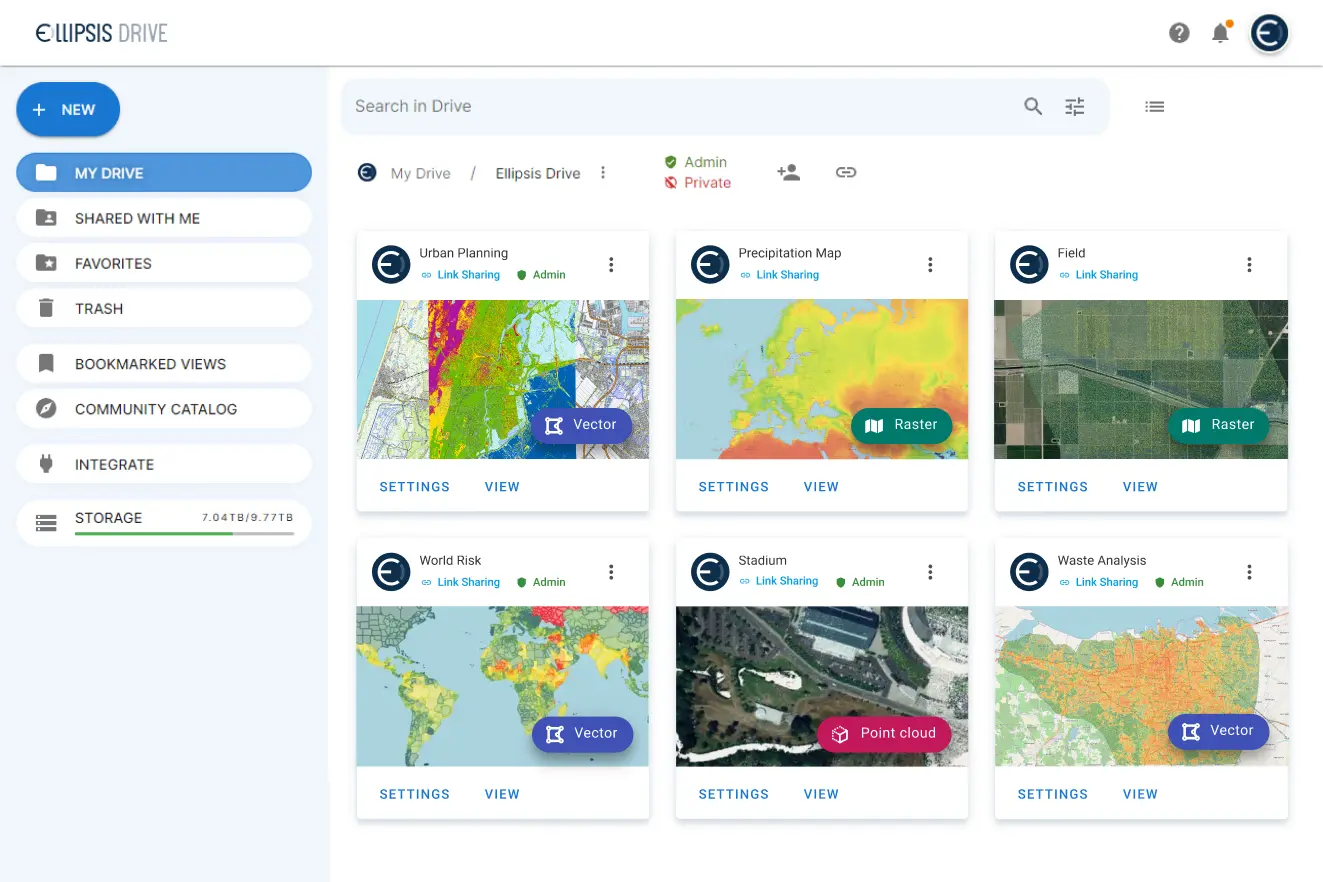
Ellipsis Drive addresses the data management, cataloging, access, and delivery portion of this analysis. It catalogs spatial data across existing storage systems, manages access and permissions, and serves datasets to teams and applications through interoperable web services. It also connects with existing GIS tools and systems.
That gives teams an infrastructure option to evaluate while continuing to develop their own applications and specialist workflows. The analytical model and the way customers use its results remain decisions for the organization building the service.
The practical decision criterion is whether the infrastructure option meets the required workflow at an acceptable lifecycle cost, with clear ownership. A custom build should have a defined reason to exist and a funded plan for maintenance. A purchased solution should demonstrate its fit through actual lifetime use. In either case, the engineering plan should show which business priorities the team can deliver with the capacity that remains.
Liked what you read?
Subscribe to our monthly newsletter to receive the latest blogs, news and updates.
Take the Ellipsis Drive tour
in less than 2 minutes'
- A step-by-step guide on how to activate your geospatial data
- Become familiar with our user-friendly interface & design
- View your data integration options