Earth Observation
Expert's Opinion
Data Discoverability: Turning Availability into Action
Contents
The Status Quo: Is Your Spatial Data Discoverable?
Consider this: A flood monitoring team is tasked with assessing rising water levels after heavy rainfall. They know relevant satellite imagery exists. They know internal datasets from previous years could help. There may even be third-party data available that adds critical context.
But instead of analyzing the situation, the team spends days, sometimes weeks, working the data into a palatable form.
This is the status quo.
In a recent interview, we posed a legitimate question regarding data discoverability to Ellipsis Drive’s co-founders: How easily can users explore and identify the data available to them?
“Data discoverability is all about how easily users can explore which datasets are available to them… both data owned by their organization, and data that is still out there in the market,” said Ellipsis Drive CEO Rose van der Maas.
Data discoverability is about being able to find, understand, and evaluate data. Fast.
Despite its importance, the current landscape of data discoverability is anything but seamless. “Solutions are either optimized to make in-house data more discoverable, or to make certain collections of third-party data more discoverable,” said our CTO, Daniel van der Maas.
Very few systems bridge both worlds effectively.
The consequence of this? Organizations are left navigating a patchwork of tools (internal catalogs, external marketplaces, and custom pipelines), none of which provide a unified view of available spatial data.
Understanding User Demand
The current state of discoverability is fragmented, but expectations from users are moving in the exact opposite direction. Users expect clarity, speed, and flexibility.
They want to be able to search across both internal and external datasets in a single flow. They expect results to be structured, comparable, and enriched with enough context to quickly assess relevance. And increasingly, they want to preview and validate data before committing to use it.
“Users are eager for a solution that makes it easy for them to perform a flexible search… based on well-indexed and unified metadata, and to be able to explore this content with a quick preview.” commented Rose.
This expectation is a direct response to how the data landscape has evolved. Organizations today are pulling in spatial data from a growing number of internal systems and external providers. At the same time, more teams across the business (from analysts to product teams) are relying on that data to drive decisions.
But when discoverability doesn’t keep up, the impact is immediate. Professionals spend weeks hunting for relevant datasets instead of using them. And decision-making slows down, not due to a lack of data, but due to the inability to find and trust what’s already available.
“A lot of potentially relevant data simply gets lost in the noise,” said Daniel.
What It Takes to Make Data Discoverable
If user expectations are clear, the next question is: What actually needs to exist under the hood to make discoverability work?
Well, data discoverability is the result of how data is structured, managed, and exposed across an entire system. At the foundation lies metadata. Every dataset needs to be clearly described i.e. what it contains, where it comes from, how it was created, and how it can be used. Without this layer of context, even the most valuable data becomes effectively invisible. As Rosalie emphasizes, discoverability depends on “well-indexed and unified metadata.” That “unified” aspect is critical. Metadata cannot live in isolated pockets; it needs to be consistent and connected across systems.
But metadata alone isn’t enough.
To make data truly discoverable at scale, organizations need indexing and cataloging mechanismsthat allow users to search, filter, and navigate across large volumes of data. This is what transforms static datasets into something that can actually be explored.
The challenge, as Daan pointed out, is that most existing solutions only solve part of the problem. Some are optimized for internal data, others for external datasets. But very few provide a unified search layer across both.
Ensuring discoverability across this fragmented landscape requires standardization (in data formats, schemas, and protocols) so that datasets can be understood and queried consistently, regardless of where they originate.
On top of that, modern discoverability also depends on APIs and queryable interfaces. It’s no longer just humans searching for data. Applications, analytics tools, and automated workflows need to be able to discover and access datasets programmatically.
And finally, there’s governance and access control.
Not all data should be visible to everyone. Effective discoverability needs to strike a balance of making data easy to find for the right users, while maintaining control, security, and compliance.
Taken together, these elements (metadata, indexing, standardization, APIs, and governance) form the backbone of discoverability.
The Business Impact of Data Discoverability
When data becomes truly discoverable, the shift is immediate and measurable —
- Speed of Access
Teams no longer spend days searching across systems or chasing colleagues for access. Instead, they can quickly identify, assess, and use the right datasets. That shift alone has a ripple effect across the organization.
- Efficient Use of Data Resources
Without discoverability, a lot of the acquired spatial data remains underutilized. In many cases, teams unknowingly recreate or even repurchase datasets that already exist within the organization. With strong discoverability, that changes. Existing datasets are surfaced, understood, and reused. This ensures that organizations actually extract value from the data they already have.
- Improved Collaboration
When data is easy to find and understand, it becomes easier to share across teams. Analysts, developers, and operational teams can work from the same pool of discoverable data rather than operating in silos. This creates a more connected data environment, one where insights are not locked within specific teams or systems, but can flow across the organization.
- Faster Innovation
As Daan notes, “When experts and analysts can quickly discover and access the right datasets, they can create and deploy new services, data products and applications much more efficiently.” Developers can experiment faster. Analysts can combine datasets more freely. New use cases can emerge without being blocked by the friction of finding and preparing data.
Ultimately, the value of discoverability comes down to this: It transforms data from something that is stored… into something that is actively used.
Conclusion
The geospatial industry has made real progress in improving how data is accessed. But access alone was never the end goal. Because the real challenge begins after the data is available.
If users cannot find, understand, and confidently use the data within their workflows, its value remains unrealized. Discoverability is what bridges that gap of turning scattered datasets into something navigable, usable, and ultimately impactful.
As data volumes and sources continue to grow and organizations become increasingly data-driven, the question is no longer whether data exists. It’s whether teams can actually see what they have, and act on it.
And that is what will define the next phase of geospatial maturity.
Liked what you read?
Subscribe to our monthly newsletter to receive the latest blogs, news and updates.
Take the Ellipsis Drive tour
in less than 2 minutes'
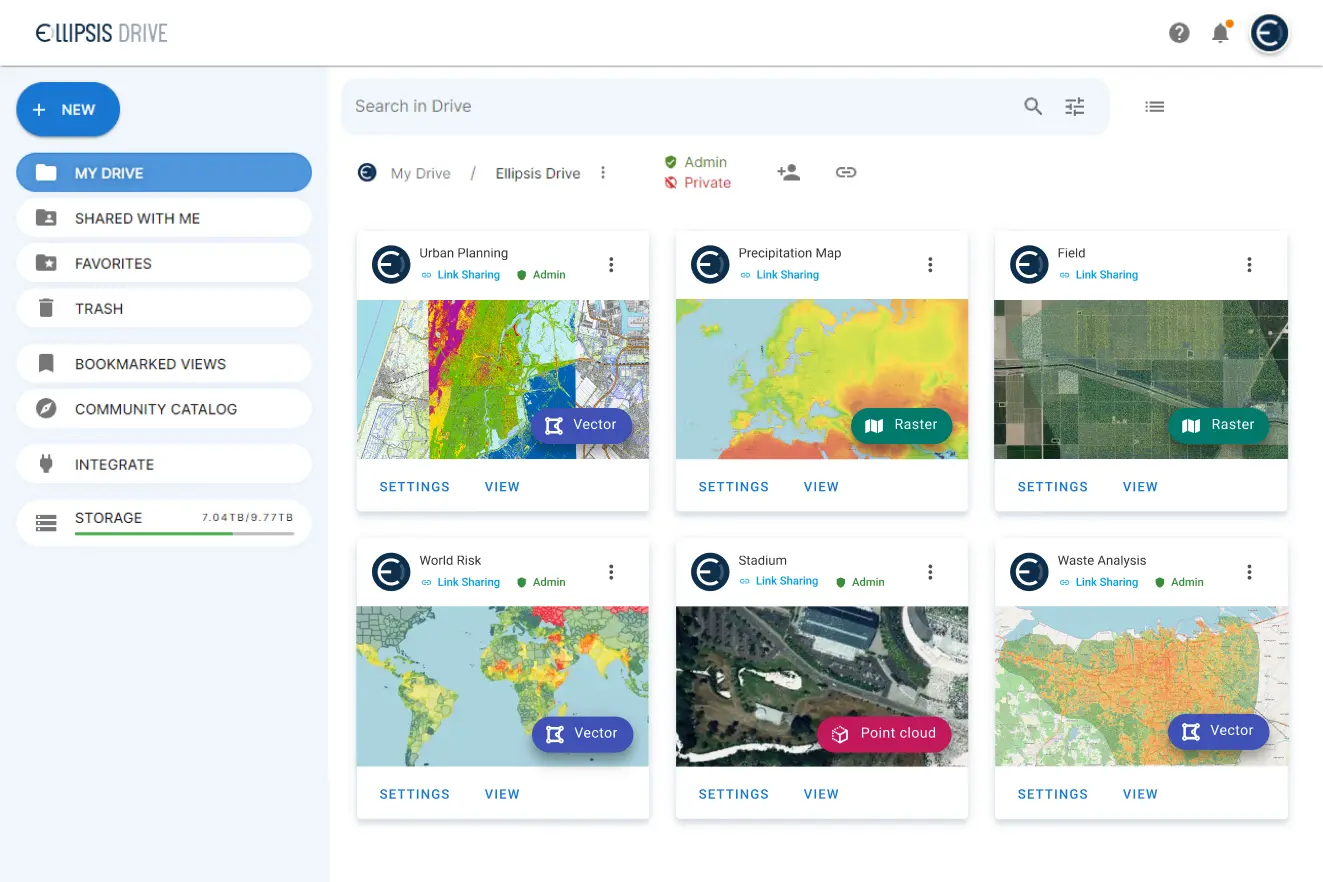
- A step-by-step guide on how to activate your geospatial data
- Become familiar with our user-friendly interface & design
- View your data integration options
Related Articles

Infrastructure for a Multi-Cloud Environment
In our previous pieces on data location and sovereignty in Earth Observation (EO) ecosystems, we explored a question that has always existed, but has grown in priority: where is your geospatial data
5 min read
Rethinking Geospatial data Sovereignty in Europe Ft. CloudFerro
The topic of data sovereignty is often reduced to a question of where data is stored. But in practice, it is far broader than location. It is about having full control and final authority over the en
6 min read
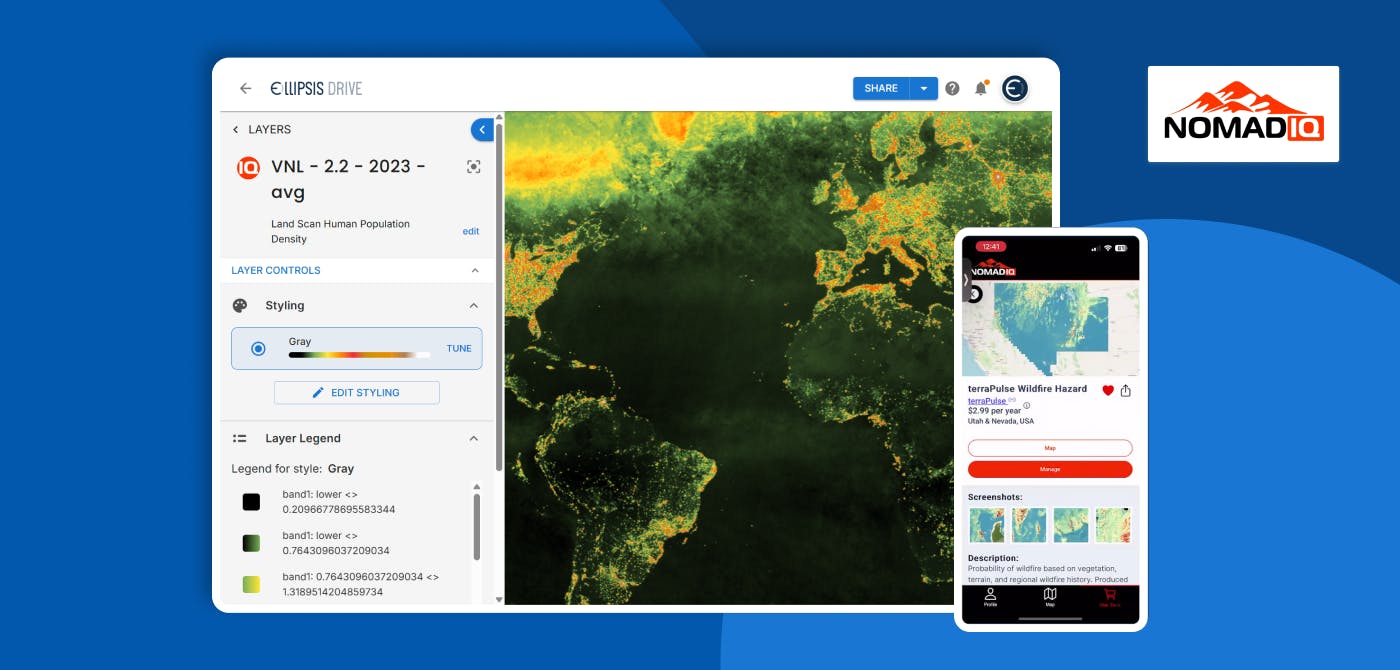
Connecting Earth Observation Datasets to End Users Ft. NomadIQ
“From established basic research and government land management to growing demand in carbon markets, hazard insurance, and even recreational apps, there's a rapidly developing market for satellite-ba
5 min read