Earth Observation
Rethinking Geospatial Democratization
Contents
Introduction: What Is Geospatial Democratization?
What does it really mean to democratize geospatial data?
Is it about making Earth Observation (EO) imagery easier to discover?
Is it about lowering the barriers to access through marketplaces and APIs?
Or is it about enabling more users, across industries, to actually generate value from it?
At its core, geospatial democratization refers to making spatial data more widely accessible and usable so that a broader range of users can derive meaningful insights from it. However, for the past few years, the industry has largely aligned the definition around only one metric: Accessibility. Platforms and data marketplaces have made it significantly easier to search, purchase, and retrieve geospatial data from a growing network of providers. By many measures, this is real progress.
But access alone does not equate to adoption. And it certainly does not guarantee impact.
Because the moment data is accessed, a far more complex journey begins, one that is often overlooked in conversations around “democratization.”
In this blog, we will take you through that journey.
Accessibility is the Beginning, not the End
The industry’s focus on accessibility has driven the rise of data marketplaces and platforms that connect satellite operators, data providers, and end users across sectors. Today, accessing EO data is easier than it has ever been.
But easier access does not necessarily translate into meaningful uptake. Access may open the door, but it does not ensure that users can walk through it.
A centralized access point solves only one part of the problem i.e. getting data into the hands of users. What it does not solve is everything that comes next. The ability to integrate that data into existing systems, combine it with other datasets, and use it effectively within operational workflows remains a significant challenge. In most cases, this slow adoption of geospatial data is a reflection of deeper infrastructural and usability constraints within organizations.
And yet, the industry continues to celebrate accessibility as a proxy for democratization, thereby insufficiently acknowledging the complexity that begins the moment data is delivered and needs to be made usable across teams and systems downstream.
The Data Provider–User Vacuum
For the data provider, the transaction is complete once a user purchases the data. The data has been delivered, the KPI has been met. But for the user, this is where the real work starts. And that work is far from trivial.
Before any meaningful analysis can take place, users are often required to navigate a series of operational hurdles: transferring data via FTP or cloud buckets, working with raw APIs, migrating datasets into internal repositories, and ensuring compatibility with existing systems. What follows is an equally demanding process of cleaning, transforming, and structuring that data into formats that are actually usable.
A typical workflow might involve downloading raw data, processing it into analysis-ready formats, integrating it with other datasets, visualizing it, and maintaining metadata throughout. Mind you, all this occurs before a single insight is derived.
This creates a clear vacuum between data provider and data user. While providers are incentivized to sell and distribute data, the responsibility of making that data usable is almost entirely pushed downstream.
The result is a fragmented, often manual process where the burden of extracting value sits squarely with the user.
From Access to Usability
Making data available is not the same as making it usable. Usability is where the other side of the coin of democratization begins. For geospatial data to deliver value, it needs to fit seamlessly into existing workflows, ready to be combined, analyzed, and acted upon without requiring extensive manual intervention.
This is where many organizations face friction. Even well-established spatial data infrastructures, designed to support core workflows reliably, are not always equipped to handle the scale, variety, and velocity of external data sources. As a result, teams often rely on custom scripts, one-off pipelines, and manual processes to bridge the gap. Although, this slows down operations and limits scalability.
The good news is that the industry has recognized this, and we’re beginning to see a shift in the market. Data providers are evolving into broader “Earth intelligence platforms,” aiming to not only distribute data but also enable its immediate use and analysis. The goal is clear: reduce the operational burden on users and bring data closer to a state where it can be directly consumed.
Because if democratization is truly the objective, success cannot solely be measured by how easily data is accessed, but by how easily it can be used.
Conclusion: Rethinking What Democratization Really Means
Geospatial data has never been more accessible. And yet, accessibility alone has not unlocked the level of adoption the industry once envisioned.
The gap lies in what happens next.
If democratization remains the industry’s North Star, our collective focus on data accessibility should expand to include data usability alongside it. The focus must shift from delivering datasets to delivering outcomes. From simplifying entry points to simplifying entire workflows. Because in the end, the success of geospatial data is not defined by how easily it can be found or purchased, but by how effectively it can be put to work in operational workflows to support cross-industry decision making.
Liked what you read?
Subscribe to our monthly newsletter to receive the latest blogs, news and updates.
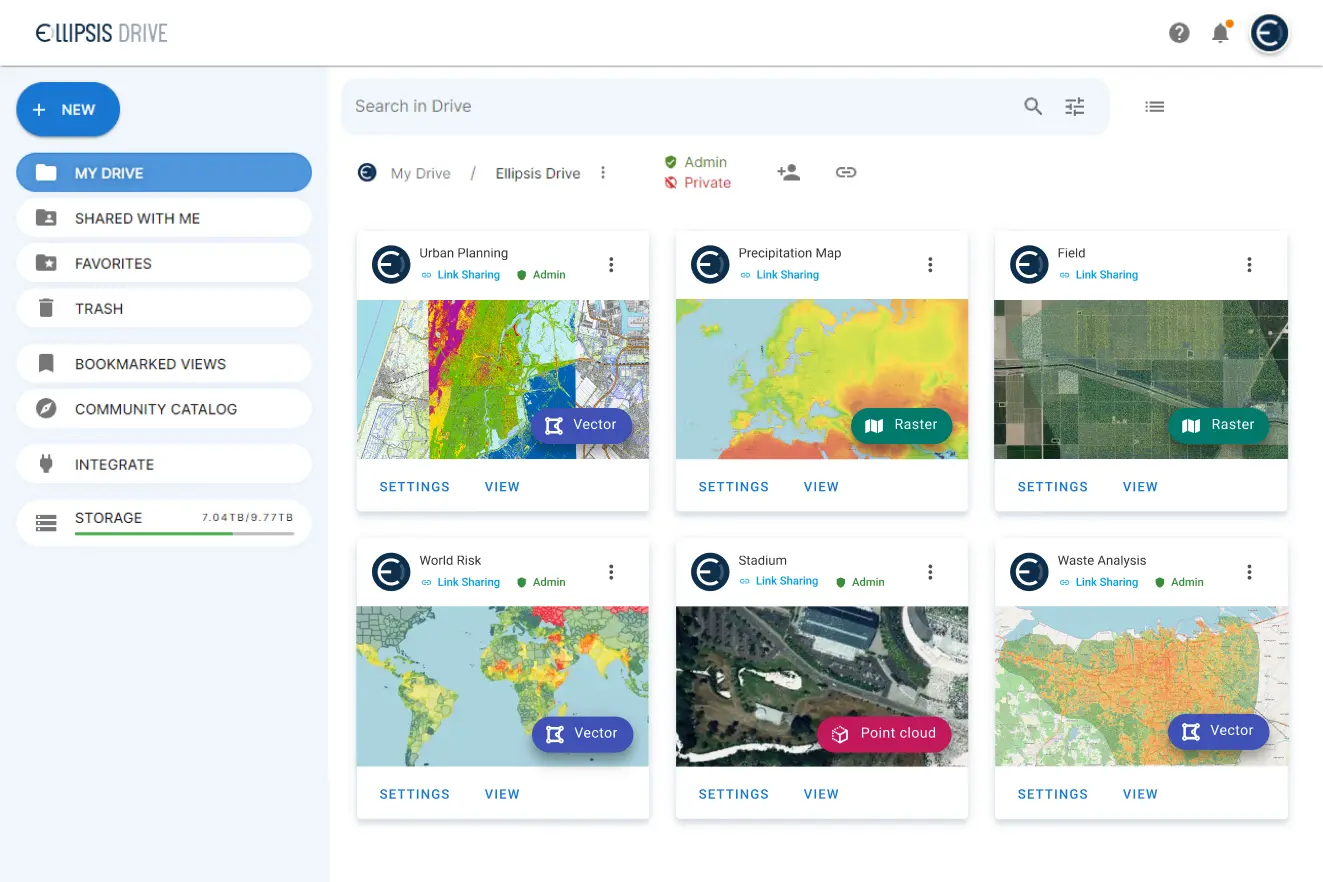
Take the Ellipsis Drive tour
in less than 2 minutes'
- A step-by-step guide on how to activate your geospatial data
- Become familiar with our user-friendly interface & design
- View your data integration options
Related Articles

Infrastructure for a Multi-Cloud Environment
In our previous pieces on data location and sovereignty in Earth Observation (EO) ecosystems, we explored a question that has always existed, but has grown in priority: where is your geospatial data
5 min read
Rethinking Geospatial data Sovereignty in Europe Ft. CloudFerro
The topic of data sovereignty is often reduced to a question of where data is stored. But in practice, it is far broader than location. It is about having full control and final authority over the en
6 min read
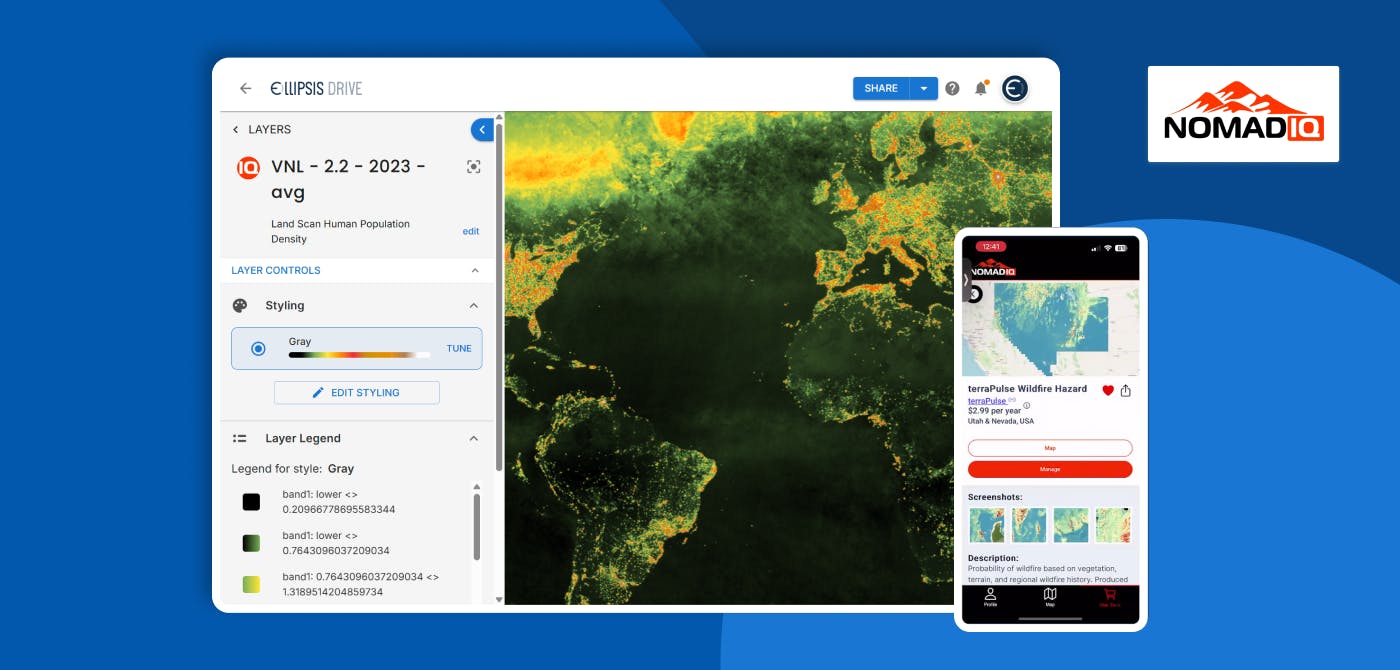
Connecting Earth Observation Datasets to End Users Ft. NomadIQ
“From established basic research and government land management to growing demand in carbon markets, hazard insurance, and even recreational apps, there's a rapidly developing market for satellite-ba
5 min read